
Clinical evaluation of different ankle joint stiffnesses – A modular testing orthosis as a tool for customized AFO treatment
This article describes the development and testing of a modular testing orthosis as a tool for everyday clinical practice. The orthosis allows for variation in stiffness around the ankle joint and the metatarsophalangeal joints, as well as adjustment of the neutral angle at the ankle joint. It is intended to serve as a tool for selecting orthotic configurations that best meet the individual treatment goals of patients. In an initial study, the orthosis was tested on a subject with lower-limb-predominant spastic hemiparesis and a retrograde gait pattern. The fundamental applicability of the concept in routine clinical practice was confirmed. The results form the basis for further research on objective decision-making and the application of the findings to definitive treatments.
1 Kompetenzzentrum Kramer, Papenburg
2 Labor für Biomechatronik, FH Münster, Steinfurt
3 MUUV GmbH, Münster
4 Sozialpädiatrisches Zentrum Westmünsterland, Coesfeld
5 Sozial-Pädiatrisches Ambulanz- und Therapiezentrum SPATZ, Meppen
Introduction
Dynamic ankle-foot orthoses (AFOs) are assistive devices designed to support patients with abnormal gait patterns [1]. AFOs are used in various neurological and musculoskeletal conditions to stabilize and provide functional support to the lower extremities during ambulation [2]. Their effect is primarily based on the transfer of resistive torques to the patient’s lower extremities [3].
The relationship between these resistive torques and the AFO’s deformation angle is referred to as AFO stiffness. A distinction is made primarily between stiffness around the ankle joint and the metatarsophalangeal joints. The literature generally assumes a linear relationship, such that an orthosis can be characterized by its ankle and footplate stiffness [4].
Studies show that ankle joint stiffness, in particular, is a key factor in the quality of the treatment provided [5] (for information on the influence of ankle stiffness on pathological gait patterns, see, e.g., [3, 5–13]). At the same time, AFO stiffness should be tailored individually to each patient and depends on the treatment goal as well as on factors such as pathology, muscle tone, and anatomy [6, 7]. Appropriate care therefore requires that the stiffness of the orthoses be tailored as precisely as possible to each patient’s specific gait disorder.
In clinical practice, the ankle and footplate stiffness of AFOs are often determined based on gait analysis measurements, the experience of orthotic specialists, and clinical examination results. However, in practice, it is usually unclear whether the intended treatment goal has been achieved until the orthosis has been manufactured and its functionality has been assessed on the patient. This makes it difficult to tailor AFO stiffness in a systematic and targeted manner. A tool that allows the appropriate stiffness configuration to be determined even before the final AFO is manufactured could facilitate individual customization and also help create a larger dataset for computer-aided treatment concepts (see, e.g., [14]).
In the literature, there are various studies on the effect of AFO ankle stiffness on the gait pattern of different patient groups. For this purpose, articulated orthoses with interchangeable functional elements of varying stiffness [8–10] or passive-dynamic AFOs with variable dynamic elements were used [11–13]. However, these studies focused on investigating the effect of stiffness on the pathological gait pattern rather than on developing a tool that could be used in everyday clinical practice. Since these AFOs were customized for each individual, the systems used are only of limited suitability for such a purpose.
Therefore, as part of the ERDF/JTF project “INDiGO,” a testing orthosis was developed at a German orthopedic workshop (Kompetenzzentrum Kramer, Papenburg, Germany) in cooperation with Münster University of Applied Sciences (Steinfurt, Germany) and MUUV GmbH (Münster, Germany). It is based on the dynamic prepreg AFO following Hafkemeyer, which has been used in Germany since 2006 for various neuroorthopedic conditions [15], and is the primary treatment form provided at the workshop.
Using the testing orthosis, the AFO’s ankle and footplate stiffness, as well as its neutral angle relative to the ankle joint, can be varied, while the orthosis size can be adapted to the patient’s anatomy. It is intended to help investigate the influence of different AFO stiffness levels on the gait pattern of patients with pathological gait, in order to identify the most suitable AFO configuration for this AFO type even before the final device is manufactured.
A preliminary study was conducted to assess its applicability in everyday clinical practice. Using the testing orthosis, an instrumented gait analysis was performed to examine the effect of stiffness variation on a subject’s gait pattern. Subsequently, the tested AFO configurations were evaluated based on the gait analysis data with regard to the defined treatment goal.
This article describes the specifications of this testing orthosis as well as the results of the study.
Methods
Characterization of the Testing Orthosis
General Concept
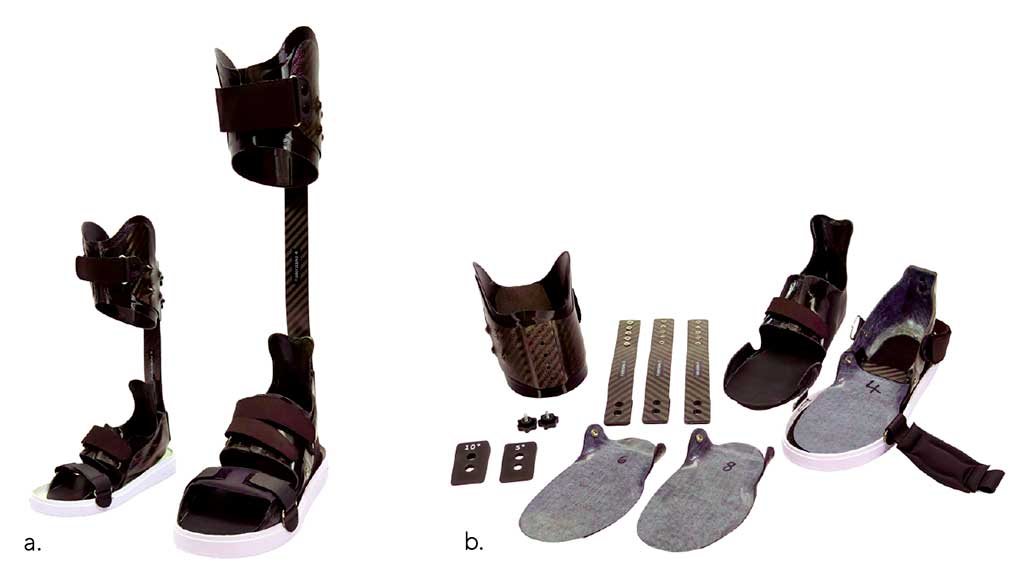
The testing orthosis is based on a modular system that can be adapted to different patient anatomies by combining prefabricated components. Calf and foot shells in various sizes (shoe sizes 30–45) as well as leaf spring elements (AFO struts) of different lengths are available for this purpose and can be combined as needed. The stiffness of the ankle and footplate components can be adjusted independently of one another by swapping out spring elements with different stiffness levels. Additionally, the neutral angle of the AFO around the ankle joint can be adjusted in increments. To replicate the roll-off behavior of an AFO inside a shoe, the orthosis is equipped with an integrated shoe sole (Fig. 1).
Variation of Ankle Stiffness and Orthosis Height
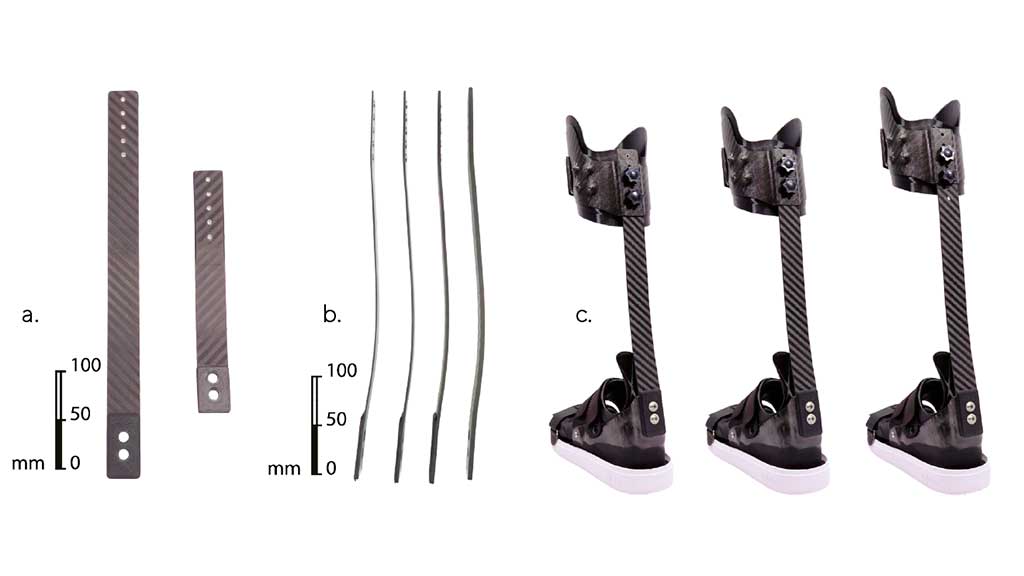
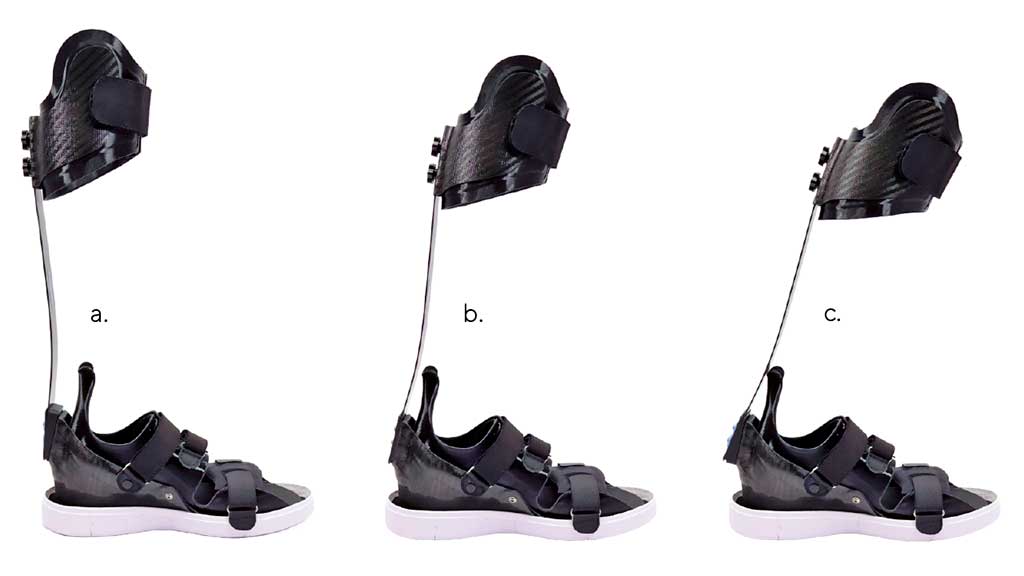
The orthosis height and its ankle stiffness can be adjusted by replacing carbon AFO struts of different lengths and flexural stiffnesses. The struts are screwed onto the foot shell of the orthosis. For more precise adjustment of the orthosis height, the calf shell can be adjusted to different heights along the AFO struts using star-head screws (Fig. 2).
Variation of Footplate Stiffness
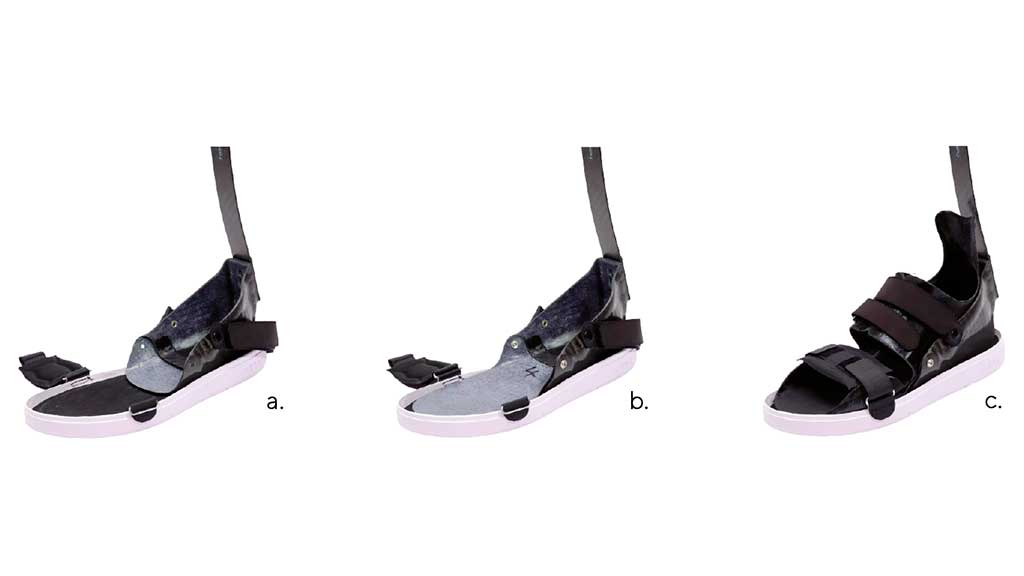
The stiffness of the footplate can also be adjusted by replacing various forefoot spring elements. To do this, the appropriate forefoot element is inserted into the foot shell and secured to the side of the shell using screws (Fig. 3).
Variation of Ankle Neutral Angle
The ankle neutral angle is adjusted by inserting predefined wedges between the foot shell and the AFO strut. It is possible to vary the ankle joint angle between 10° plantarflexion and 10° dorsiflexion. The ankle neutral angle, as defined in orthopedic technology, refers exclusively to the angle between the calf shell and the foot shell. A neutral angle of 0° corresponds to a 90° angle between the two components. The integrated shoe sole also features a heel-to-toe drop, which alters the orientation of the orthosis and makes it appear dorsiflexed. This is intended to replicate the real-world situation with an AFO in an off-the-shelf shoe (Fig. 4).
Study
This study serves as an initial basis for determining whether the testing orthosis can be used in everyday clinical practice to identify suitable, patient-specific AFO configurations. Since the literature primarily considers ankle stiffness to be relevant to the quality of patient care [16], and since the many possible variations result in an extremely large number of potential AFO configurations, this study varied only the ankle stiffness of the testing orthosis. However, further studies are planned to comprehensively investigate the applicability of the testing orthosis.
Subject Description
The study subject (male, 17 years old, 181 cm, 76 kg) presents with unilateral spastic hemiparesis predominantly affecting the left lower extremity. This is accompanied by shortening of the left triceps surae muscle with functional equinus deformity, as well as a leg length discrepancy favoring the right side. For several years, the subject has been fitted with a dynamic AFO based on the Hafkemeyer design, which has led to an improvement in gait quality and stability, as well as a more physiological gait pattern.
When walking barefoot, an alternating gait pattern is observed, with the left side being clearly shortened, characterized by primary forefoot contact followed by heel loading, consistent with a retrograde gait pattern. During the stance phase, knee flexion remains increased on the left side compared to the right, and full knee extension cannot be achieved due to increased muscle tone in the knee flexors. Additionally, during the swing phase, active dorsiflexion at the ankle joint is restricted due to the increased muscle tone.
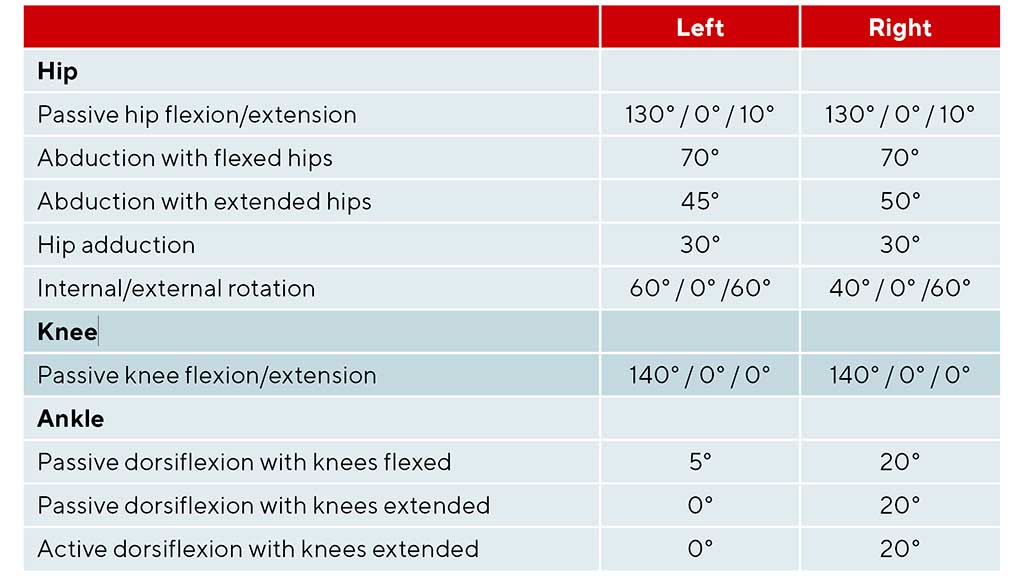
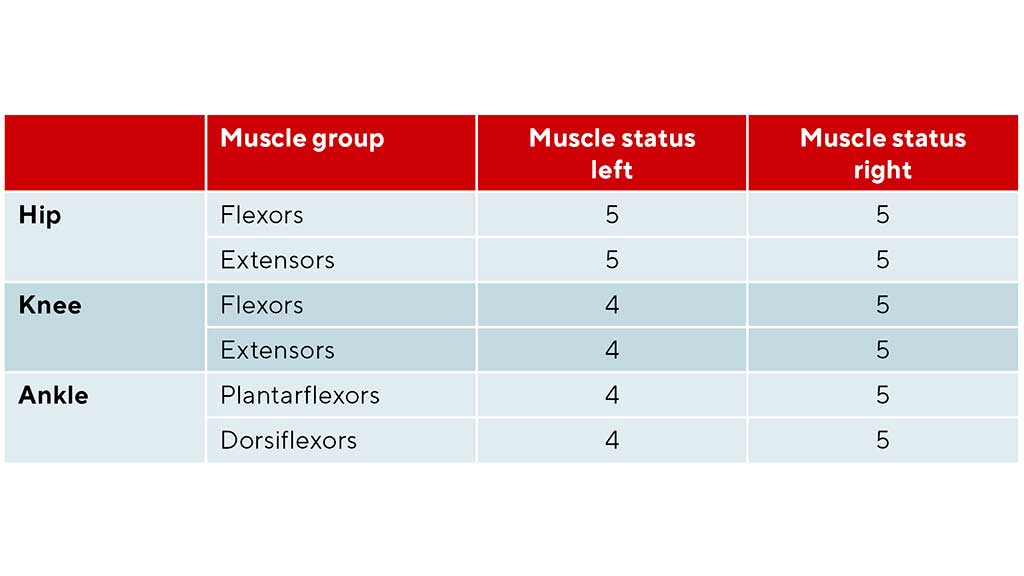
In the lower extremities, passive range of motion in the hip and knee joints is largely symmetrical. In the ankle joint, there is limited dorsiflexion on the left side due to shortening of the triceps surae muscle. The full range of motion of the lower extremities is shown in Table 1. Based on the muscle assessment according to Janda [17], the affected left side predominantly showed strength grade 4, while the hip muscles showed strength grade 5. The unaffected right side was normal throughout. This is shown in Table 2.
In order to evaluate the different ankle stiffness levels, an individualized treatment goal was defined before the start of the trial. This served as a reference for assessing the various AFO configurations. The treatment goal was defined as follows: Above all, the orthosis must ensure initial heel contact and a fully anterograde rolling movement of the foot in order to generate an external plantarflexing torque in the ankle joint and an external flexing torque in the knee during weight acceptance, thereby achieving more physiological knee kinematics. In addition, during the mid-stance phase, the orthosis should support the generation of a knee extension torque and physiological dorsiflexion of the ankle joint.
Tested AFO Configurations
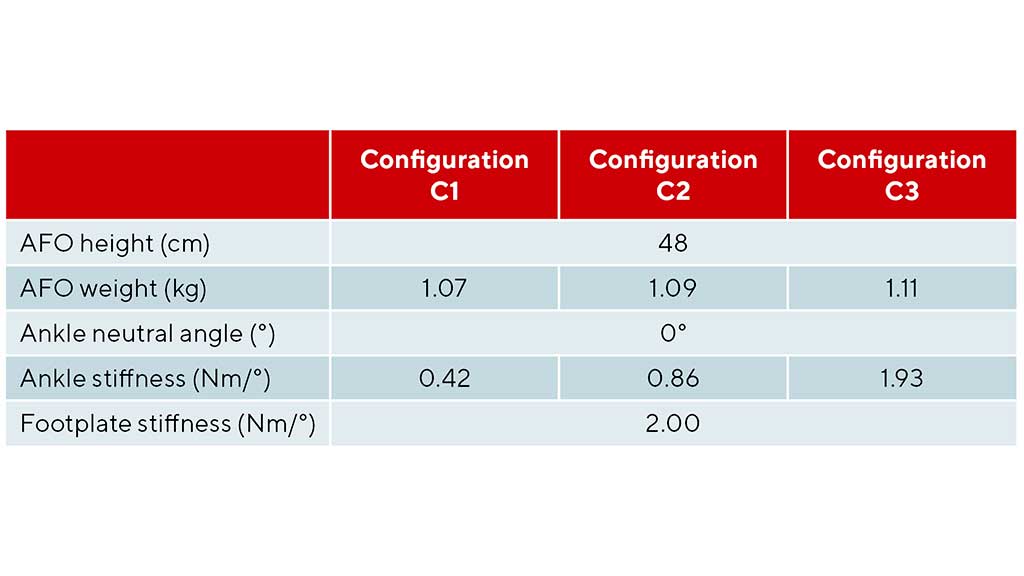
Based on the subject’s medical records, which were available prior to the study, the orthosis height, the ankle neutral angle, and the footplate stiffness of the testing orthosis to be evaluated were determined in advance. In addition, AFO struts in three different stiffness levels were selected. This resulted in three AFO configurations (C1–C3) which were deemed appropriate by the workshop and are frequently used in routine clinical practice. The three configurations were then characterized and tested by the Biomechatronics Research Laboratory (FH Münster University of Applied Sciences, Steinfurt, Germany). The testing technology used is described in [18]. The specifications of the resulting orthosis configurations are listed in Table 3.
Study Protocol
The study was conducted in the gait analysis laboratory of the Social Pediatric Center (SPZ) Westmünsterland in Coesfeld, Germany. The subject first walked barefoot (BF) and then with three different AFO configurations in a randomized order on a twelve-meter-long gait analysis track (measurement distance approximately nine meters). Kinematic gait parameters were recorded using the Vicon Nexus 2.18 system (marker model: Vicon Plug-in-Gait lower body; Vicon Motion Systems Ltd, Yarnton, United Kingdom), and ground reaction forces were measured using two OR6‑6 force plates (AMTI, Watertown, USA). Each configuration was measured until the force plates were struck reproducibly five times across their entire surface by the affected foot. These five measurements served as the basis for calculating mean values and standard deviations (SD).
Each measurement run was followed by a ten-minute break and a five-minute acclimatization period for the next configuration. In addition, the replacement time of the struts was documented, and the subject was asked about pain, pressure points, or other complications.
Although some studies objectively determine the optimal patient-specific ankle stiffness using respiratory gas analysis or pulse measurements, there is currently no standard for determining the best AFO configuration [10, 13]. Therefore, and since these measurement methods are rarely used in the treatment approach addressed here, a practical but subjective approach was chosen for this study. The configurations were evaluated by clinical staff at the SPZ Westmünsterland and orthopedic technicians at the collaborating workshop after the measurements were completed.
Results and Discussion
Handling of the Testing Orthosis
No abnormalities were observed during the course of the study. The same applies to the handling of the testing orthosis. The subject also reported no pain or other complications. The time required to replace the spring elements averaged 87.80 s ± 10.47 s.
Gait Analysis
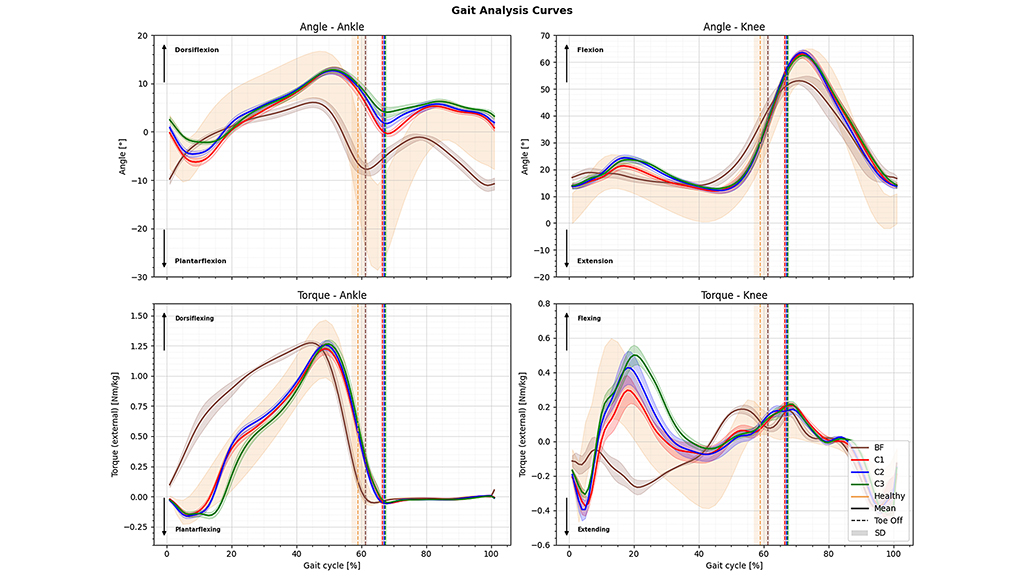
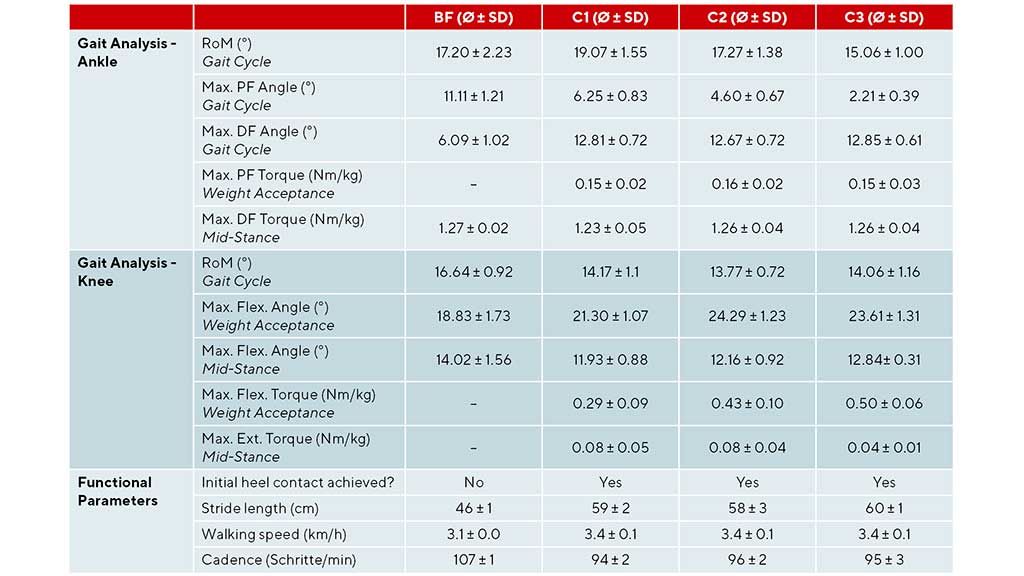
The results of the study are presented in Table 4. Figure 5 shows the curves from the gait analysis. The ankle angle reflects the angle between the foot shell of the orthosis and the subject’s lower leg and therefore does not correspond to the anatomical angle of motion in the subject’s ankle joint.
To avoid confusion regarding the nomenclature and sign conventions for torques, only external torques are specified below. Thus, a plantarflexing torque at the ankle joint is represented by a negative value, while a dorsiflexing torque is represented by a positive value; similarly, knee extension torques are represented by negative values and knee flexion torques by positive values.
The curves show that all three AFO configurations result in clear changes compared to barefoot walking. In all configurations, initial heel contact is achieved, as evidenced by the onset of a knee-extending torque and a plantarflexing ankle torque, as well as a reduced plantarflexion angle during weight acceptance. The shock absorption phase improves due to a knee flexion torque that approaches the normal range. Positive effects are also evident in the mid-stance phase, particularly due to a knee extension torque and an increased dorsiflexion angle, which, contrary to what would be expected based on literature values, exhibits the same maximum in all configurations [3]. In addition, the maximum knee flexion angle increases during the swing phase, allowing the contralateral side to approach the physiological range.
Positive effects on gait patterns are also observed in the functional parameters. Specifically, walking speed increases while cadence decreases in each configuration, resulting in an increase in stride length.
All these aspects demonstrate that wearing the testing orthosis in each of the three configurations leads to a clear improvement in gait and fulfills the previously defined treatment goals. Nevertheless, distinctions can be made between the configurations to determine the most suitable one. Among the treatment goals, weight acceptance emerged as the most critical gait phase for treatment quality. For this reason, the curves of the ankle joint torque and the knee angle during this gait phase were specifically used as the basis for decision-making. In contrast to C1 and C2, C3 exhibited an unphysiologically prolonged plantarflexion torque with a second peak at approximately 15 % of the gait cycle and is therefore rated as more unfavorable. The knee angle curves also show that the subject exhibits reduced shock absorption during weight acceptance with C1 compared to C2 and C3, as evidenced by the smaller difference between the knee angle at initial contact and the maximum flexion angle during loading response.
The additional videos also show a high angular velocity in the ankle joint during weight acceptance with C1, while C3 appears to restrict the subject’s gait cycle too much. Since the remaining curves show little difference among the three configurations, it can be assumed that C2 is the most suitable AFO configuration for the subject among the three tested configurations. This illustrates that the treatment goal can be achieved with a dynamic AFO based on the Hafkemeyer design, and provides a reference point for determining which of the tested configurations best achieves this goal.
Limitations and Conclusion
The study described in this article supports the hypothesis that the presented testing orthosis can be used in everyday clinical practice as a tool for identifying a suitable AFO configuration in the Hafkemeyer design for patients with abnormal gait patterns. Of the three configurations tested with a wide range of ankle joint stiffness, the C2 configuration was selected as the one that best meets the intended treatment goal, based on an evaluation by clinical and orthopedic technical specialists. The results also provide a basis for further studies in which, in addition to ankle stiffness, footplate stiffness, the ankle neutral angle, and, if necessary, other parameters will be varied to investigate their influence on gait.
The testing orthosis can be used to evaluate AFO configurations in the Hafkemeyer design, thereby establishing a foundation for the systematic evaluation of this type of AFO. The current design of the testing orthosis is tailored to this AFO type. Other AFO types that may also be effective (e.g., those with a ventral fit) cannot currently be evaluated using this testing orthosis. It should also be noted that even wearing conventional shoes can affect the pathological gait pattern. In this study, the effects of the various AFO configurations were compared to the subject’s barefoot gait; consequently, effects caused by wearing only shoes were not considered separately.
The study focused on selecting the most appropriate AFO stiffness for each individual from among the configurations examined. Due to the small sample size of n = 1, the results should be considered an isolated case and cannot be generalized to other patients. For the same reason, any deviations from findings in the literature (such as a consistent maximum dorsiflexion angle) are not discussed here and should be investigated more specifically in future studies.
The study also demonstrates the fundamental applicability of the testing orthosis as a tool for clinically testing different AFO configurations. However, due to the modular design, the adjustable parameters are only available in discrete steps, meaning that the optimal individual configuration may lie between these steps. The different ankle stiffnesses led to biomechanically plausible changes in the gait phases relevant to the orthosis’s effect. At the same time, the gait analysis curves showed similar patterns despite the comparatively large differences in stiffness. This may indicate that the effects of finer stiffness gradations can only be captured to a limited extent with the measurement methods used. The role that possible compensatory movements play in this context should be further investigated in studies with larger sample sizes.
This highlights the need for a more detailed and comprehensive investigation of how different ankle stiffness levels affect the gait pattern of patients with abnormal gait. There is also a research gap regarding how to identify the optimal, patient-specific AFO configuration. In this study, the selection of the appropriate configuration was based on clinical and biomechanical evaluations conducted by the participating healthcare professionals. Since this evaluation involves a professional interpretation of the collected data, different healthcare professionals may arrive at differing assessments.
Testing tools such as the testing orthosis presented here could enable these knowledge gaps to be systematically addressed in the long term and help develop more objective decision-making criteria for treatment. The testing orthosis allows for a targeted analysis of how various design parameters influence gait behavior. Furthermore, by maintaining consistent test conditions, it can serve as a basis for developing a decision-making guide that allows for a structured and objective comparison of the quality of care provided by different AFO configurations.
To further investigate this, Kompetenzzentrum Kramer, the SPZ Westmünsterland, and FH Münster University of Applied Sciences are planning larger-scale field trials. In these trials, footplate stiffness and the ankle neutral angle will also be varied in order to evaluate the testing orthosis with respect to these parameters and to examine their influence on gait patterns. In addition, an objective decision-making guideline has been developed to compare the quality of care provided by different AFO configurations for patients with hemiparesis and retrograde roll-off behavior, and it will be tested as part of these studies. Furthermore, investigations are ongoing into how the stiffness values identified as appropriate using the testing orthosis can be transferred to the final AFO fitting (see, e.g., [20]).
In the long term, the goal is to test and validate a comprehensive approach that will supplement and support experience-based decision-making in orthopedic technology with objective data, and integrate the insights gained into everyday AFO manufacturing processes.
Peer reviewed paper
For Authors:
Christina Krieger
B. Eng. Technische Orthopädie
Kompetenzzentrum Kramer
Gasthauskanal 2
26871 Papenburg
c.krieger@kramer-gruppe.net
Krieger C et al. Verschiedene Sprunggelenkssteifigkeiten klinisch erproben – eine modulare Testorthese als Werkzeug für die individuelle AFO-Versorgung. Orthopädie Technik, 2026; 77 (11): 32–39
Figures and tables:
References
[1] Perry J, Burnfield JM. Gait analysis: normal and pathological function. 2. Auflage. Thorofare, NJ: SLACK, 2010
[2] Zhou C, Yang Z, Li K, Ye X. Research and development of ankle-foot orthoses: a review. Sensors, 2022; 22 (17): 6596. doi: 10.3390/s22176596
[3] Totah D et al. The impact of ankle-foot orthosis stiffness on gait: a systematic literature review. Gait & Posture, 2019; 69 (8): 101–111. doi: 10.1016/j.gaitpost.2019.01.020
[4] Bregman DJJ et al. A new method for evaluating ankle foot orthosis characteristics: BRUCE. Gait & Posture, 2009; 30 (2): 144–149. doi: 10.1016/j.gaitpost.2009.05.012
[5] Skigen JT et al. Customized passive-dynamic ankle-foot orthoses can improve walking economy and speed for many individuals post-stroke. Journal of NeuroEngineering and Rehabilitation, 2024; 21 (1): 126. doi: 10.1186/s12984-024–01425‑7
[6] Böhm H, Dussa CU. Prefabricated ankle-foot orthoses for children with cerebral palsy to overcome spastic drop-foot: does orthotic ankle stiffness matter? Prosthetics and Orthotics International, 2021; 45 (6): 491–499. doi: 10.1097/PXR.0000000000000050
[7] Waterval NFJ et al. Stiffness-optimized ankle-foot orthoses improve walking energy cost compared to conventional orthoses in neuromuscular disorders: a prospective uncontrolled intervention study. IEEE Transactions on Neural Systems and Rehabilitation Engineering, 2020; 28 (10): 2296–2304. doi: 10.1109/TNSRE.2020.3018786
[8] Kerkum YL et al. The effects of varying ankle foot orthosis stiffness on gait in children with spastic cerebral palsy who walk with excessive knee flexion. PLOS One, 2015; 10 (11): e0142878. doi: 10.1371/journal.pone.0142878
[9] Yamamoto S, Miyazaki S, Kubota T. Quantification of the effect of the mechanical property of ankle-foot orthoses on hemiplegic gait. Gait & Posture, 1993; 1 (1): 27–34. doi: 10.1016/0966–6362(93)90040–8
[10] van Noort L et al. A usability study on the inGAIT-VSO: effects of a variable-stiffness ankle-foot orthosis on the walking performance of children with cerebral palsy. Journal of NeuroEngineering and Rehabilitation, 2024; 21 (1): 132. doi: 10.1186/s12984-024–01433‑7
[11] Kerkum YL, Philippart W, Houdijk H. The effects of footplate stiffness on push-off power when walking with posterior leaf spring ankle-foot orthoses. Clinical Biomechanics, 2021; 88 (2): 105422. doi: 10.1016/j.clinbiomech.2021.105422
[12] Russell Esposito E et al. How does ankle-foot orthosis stiffness affect gait in patients with lower limb salvage? Clinical Orthopaedics and Related Research, 2014; 472 (10): 3026–3035. doi: 10.1007/s11999-014‑3661‑3
[13] Waterval NFJ et al. Precision orthotics: optimising ankle foot orthoses to improve gait in patients with neuromuscular diseases; protocol of the PROOF-AFO study, a prospective intervention study. BMJ Open, 2017; 7 (2): e013342. doi: 10.1136/bmjopen-2016–013342
[14] Schröder J‑H et al. Neuartige modulare Gehorthese zur leistungsfähigen Korrektur von Gangabweichungen bei neurologisch bedingten Gehstörungen. Orthopädie Technik, 2022; 73 (4): 62–67
[15] Hafkemeyer U et al. Dynamische Unterschenkelorthese in Prepreg-Technik nach Hafkemeyer – Konstruktionsmerkmale, Indikationen, Variationsmöglichkeiten. Orthopädie Technik, 2024; 75 (4): 48–54
[16] Wang JZ et al. Mechanical testing methods for determining stiffness of ankle-foot orthoses: a scoping review. Prosthetics and Orthotics International, 2025. doi: 10.1097/PXR.0000000000000478
[17] Smolenski UC et al. Janda Manuelle Muskelfunktionsdiagnostik. 7. Auflage. München: Urban & Fischer, 2025
[18] Kirillov M. Prüfung und Bewertung von Unterschenkel-Orthesen. Technische Universität Berlin, 2026. doi: 10.14279/depositonce-26460
[19] Schwartz MH, Rozumalski A, Trost JP. The effect of walking speed on the gait of typically developing children. Journal of Biomechanics, 2008; 41 (8): 1639–1650. doi: 10.1016/j.jbiomech.2008.03.015
[20] Strenge O, Hochmann D. Analytical stiffness prediction method for idealized passive dynamic ankle-foot orthoses under standardized bench test conditions. Transactions on Additive Manufacturing Meets Medicine, 2026; 8 (1): 2755. doi: 10.18416/AMMM.2026.26062755
- Additiv herstellbare aktive Fingerprothesen — 9. November 2026
- Auswahl von Prothesenkniegelenken für Oberschenkelamputierte: Haben mechanische Kniegelenke noch einen Platz in der Versorgung? — 6. November 2026
- Verschiedene Sprunggelenkssteifigkeiten klinisch erproben – eine modulare Testorthese als Werkzeug für die individuelle AFO-Versorgung — 28. Oktober 2026